

Every adhesive and sealant is comprised of chemical substances whose elements are arranged in ways with a certain number of protons each. Before we can understand how these substances react, cure, or bond, we must first be able to read the chemical formulas that represent them.
Chemical formulas are written using standardized symbols, letters, numbers, and lines to represent the composition of a substance. These processes allow chemists worldwide to understand chemical composition regardless of language.
In bonding science, molecular and structural formulas represent adhesive ingredients such as epoxy resins, curing agents, polyurethanes, acrylics, solvents, and silicone. If you can read these formulas, you will easily understand how adhesives cure, why different adhesives perform differently, and how molecular structure impacts adhesive behavior.
In this article, we describe methods for reading molecular and structural formulas so you can engage with adhesive labels more deeply.
Understanding Chemical Symbols
The initial step in reading any chemical formula is to identify the chemical symbols that represent each element. Every element on the periodic table has a unique one- or two-letter symbol, where the first letter is always capitalized and the second letter, if present, is in lowercase. For example, the letter H represents hydrogen, the letter C represents carbon, and the letter N represents nitrogen. Each symbol represents one atom of the element unless there is a number after it. These symbols are standardized internationally, so chemists can identify which elements are present in a molecule just by reading the formula.
Understanding the Subscripts
After identifying the element symbols, the next step is to read the subscripts. A subscript is a small number written immediately after an element symbol that indicates how many atoms of the element are present in a single molecule. For example, for the substance water, the formula H₂O means there are 2 hydrogen atoms and 1 oxygen atom. If there are no subscripts after the atom letter, there is only one atom of that element.
Reading Molecular Formulas
Once you grasp the fundamentals of chemical symbols and subscripts, it is relatively easy to read molecular formulas. The hard part is simply remembering which letter(s) correspond to which element. For example, H₂O represents 2 hydrogen atoms and 1 oxygen atom, and we know from its configuration that it produces water. More complex formulas like C₃H₈ represent 3 carbon atoms and 8 hydrogen atoms, producing the substance propane. Many adhesive ingredients have molecular formulas that can become very complex, with molecules containing dozens or hundreds of atoms of their constituent elements. While they are more complex, they are still interpreted using the same basic principles of chemical symbols and subscripts.
What Molecular Formulas Tell You
A molecular formula provides several pieces of information that help us determine what type of molecule it is. Firstly, the chemical symbol, consisting of one or two letters, tells us which elements are present. Secondly, the subscript number following the element symbol tells us how many atoms of that element are present. For example, by reading C₂H₆O, you immediately know that the formula consists of 2 Carbon atoms, 6 hydrogen atoms, and 1 oxygen atom. This type of information enables chemists to compare molecules, calculate their molar mass, and determine their chemical composition.
What Molecular Formulas Do Not Tell You
Molecular formulas do provide you with information about a molecule’s composition, but they do not reveal the molecular structure. In other words, they do not provide the chemist with information about how the atoms are bonded together or the arrangement of the bonds within the molecule.
This limitation is significant because the arrangement of atoms is what determines a substance’s chemical and physical properties. Two molecules can contain the same number of atoms but behave differently because their atoms are bonded differently.
For example, ethanol and dimethyl ether both have the molecular formula C₂H₆O, and by reading it you might think they are the same substance. Still, in fact they are entirely different compounds. Their atoms are arranged differently, which gives them distinct physical and chemical properties. Ethanol is a liquid while dimethyl ether is a gas.
This provides the essential knowledge that knowing which atoms are present does not always tell us which substance it is.
Transitioning to Structural Formulas
A structural formula helps solve the limitations we described with the molecular formulas. Instead of showing only the types and numbers of atoms, it also shows how those atoms are connected.
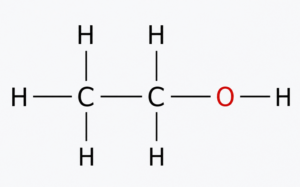
This additional information enables chemists to discern a molecule’s structure and understand why different substances exhibit distinct chemical properties even when they share the same molecular formula.
As adhesive molecules grow larger and more complex, structural formulas become more essential.
How to Read Structural Formulas
A structural formula provides the necessary detail to show how the atoms are connected by chemical bonds. A line in a structural formula represents a covalent bond. A single line represents a single covalent bond where two atoms share one pair of electrons. Two parallel lines represent a double covalent bond, in which the atoms share two pairs of electrons. Finally, three parallel lines represent a triple covalent bond, in which the atoms share three pairs of electrons.
Reading Condensed Structural Formulas
As molecules grow larger and more complex, drawing every atom and every bond can become tedious. As a result, chemists use condensed structural formulas, which show groups of atoms together and how they are connected within the molecule. CH₃CH₂OH is an example of a condensed structural formula because it indicates that one carbon atom is bonded to three hydrogen atoms and another is bonded to two hydrogen atoms. One oxygen atom is bonded to one hydrogen atom.
Structural Formulas in Adhesive Science
Structural formulas are especially useful in adhesive science because they provide information about the parts of a molecule that participate in chemical reactions during bonding. When chemists examine a structural formula, they are looking for functional groups or specific arrangements of atoms that are responsible for a chemical’s reactivity. For instance, an epoxy resin contains reactive epoxy groups that can bond with a curing agent. Likewise, acrylic adhesives contain double carbon bonds that participate in polymerization reactions.
By reading structural formulas, chemists can identify reaction regions before a chemical reaction even occurs. As you continue reading about bonding science, you will find that structural formulas become even more important when they surface in topics such as polymerization, functional groups, crosslinking, and adhesive formulation.
Conclusion
This article introduces the concept of reading molecular formulas, which is an essential skill for studying adhesive chemistry. A molecular formula describes which elements are present and how many atoms of each element are present in a molecule. Recognizing chemical symbols and interpreting subscripts allows for quick retrieval of the element type and number of atoms. A structural formula goes one step further and describes how the atoms are connected, revealing the type of molecular structure it forms.
Knowing how to read molecular and structural formulas is an essential skill for learning about bonding science and its applications in adhesive and sealant technology.
