

Adhesive joints may experience failure under sudden impact or deteriorate progressively during service life. Sometimes, the adherends will fall apart entirely. At other times, the joint can remain intact but be incapable of carrying the prescribed load, maintaining alignment, preventing leakage, or providing the intended stiffness. Symptoms such as excessive movement, cracking, partial separation, and loss of sealing performance can be indicators of adhesive joint failure.
The visible fracture doesn’t always reveal the true cause of the failure. Many reasons could lead to a joint separating at the adhesive-adherend interface, such as surface contamination, moisture exposes, or because peel or cleavage stress exceeded its capacity. A crack through the adhesive layer may represent overload, impact, fatigue, incomplete curing, or environmental degradation. Effective failure analysis must distinguish the location of the failure from the cause of the failure.
This article discusses the principal types of adhesive-joint failure, the mechanical and environmental conditions that cause them, the manufacturing defects that contribute to them, the steps needed to identify them, and the necessary precautions required to prevent them from recurring.
What is An Adhesive Joint Failure
An adhesive joint is comprised of two or more adherends connected by an intermediate adhesive layer. The boundary between the adhesive and each adherend is called the interface. For the joint to remain in operating condition, the adhesive must remain attached to both interfaces, the cured adhesion must remain intact itself, and the adherends must be strong enough to transfer load between each other.
An adhesive joint occurs when any part of this system can no longer perform its intended function. Complete separation is an obvious example, but it is not necessary for a joint to fail. A joint can fail well before the parts separate. For example, a structural joint can fail if it becomes too flexible even though it has not fractured. A sealed joint can enter failure when a trickle of fluid enters through a small crack. An aligned assembly can enter failure if creep causes one component to shift out of position.
Failure from its inception to detection or functional collapse can be sudden or progressive. Sudden failure can follow from a single overload, impact, or rapid temperature fluctuations. Progressive failure is more gradual and generally develops slowly over time through fatigue, creep, corrosion, moisture exposure, chemical interactions, or repeated thermal movement. The lead up from a progressive crack may be undetectable for a long period before the rapid final separation occurs.
Failure is typically classified by the location it occurred. The principal categories are interfacial failure, cohesive failure within the adhesive, adherend failure (substrate), mixed failure, and failure within a coating or other surface layer. Upon identifying the type of adhesive failure, further investigation can be performed on the load and service conditions to find the mechanism and root cause.
The Main Types of Adhesive-Joint Failure
The surface of the fracture can provide important clues about the source of the failure. If the adhesive remains on one adherend and the opposite surface appears untouched, the failure could have occurred at the interface, that is, between the layer of the first adherend and the adhesive. If adhesive remains on both adherends, the fracture may have occurred within the adhesive itself. If fibers, fragments, or layers of the adherend remain attached to the adhesive, the failure may have occurred within the surface layers of the adherend.
A genuine fracture is rarely attributable to a single type of failure. A joint can display several failure types in multiple regions. For example, the separation may start at the interface, and the crack may move through the adhesive.
Adhesive or Interfacial Failure
Adhesive failure, also called interfacial failure, occurs at the boundary between the adhesive and adherend. The adhesive gets dislodged from the adherend, causing the adherend to break away from the bond line.
Interfacial failure indicates the adhesive did not establish or retain a sufficiently strong connection with the adherend. Reasons for failure can include oil, dust, fingerprints, release agents, oxidation, moisture, cleaning residue, or some other contaminant. Poor wetting during assembly may also result in interfacial failure because if the liquid adhesive does not spread into close contact with the surface of the adherend, molecular attraction cannot develop.
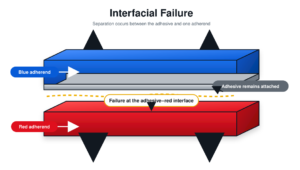
Poor surface preparation may also be a common cause. The surface may not have been cleaned, abraded, chemically treated, or primed beforehand. Some plastics do not have enough surface energy so they may need plasma, flame, corona, or chemical treatment. Metals may develop weak or unstable oxide layers. Bonding an adhesive to these materials without the correct surface preparation can leave the interface as the weakest part of the joint.
Interfacial failure may develop over the course of a joint’s lifetime. Moisture or chemicals can infiltrate through a bond edge and weaken the interface. Corrosion can develop beneath the adhesion. Likewise, repeated thermal expansion can progressively damage the connection between materials with different expansion rates.
Visual inspection may identify broad clean regions, incomplete adhesive coverage, corrosion, or surface films, but the appearance should be inspected carefully. A surface that appears clean to the eye may contain a thin or weak layer of adhesive. Further testing is possible through microscopy or chemical surface analysis.
Interfacial failure is minimized by appropriate adhesive selection and surface preparation. The adhesive must be compatible with the adherend and have surface preparations such as a primer or coating. Prepared surfaces should be protected from dust, moisture, handling, and excessive delay before application.
Cohesive Failure Within the Adhesive
Cohesive failure occurs when the fracture passes through the body of the cured adhesive layer. The adhesive remains attached to the adherends because the interfaces were stronger than the part of the adhesive that broke internally. The fracture may have the appearance of rough, torn, stretched, glassy, or granular depending on the type of adhesive.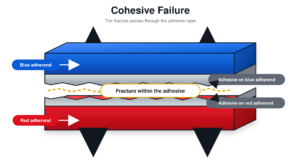
Cohesive failure during testing may be an indicator that the adhesive bonds effectively to the adherend. However, it still indicates that the adhesive failed internally.
A cohesive fracture can be caused by a load that exceeded the cured adhesive’s strength capabilities. It may result from an adhesive that is brittle and cannot withstand peel or is too flexible for a stiffness-critical joint. It may also result from insufficient resistance to the operating temperature. Incorrect mixing, incomplete curing, trapped air, excessive thickness, and expired material are all contributing factors that can reduce internal strength.
The characteristics of a fracture can provide useful information about the nature of failure. A brittle, smooth fracture can be due to rapid loading, cold temperatures, or an adhesive with limited toughness. A stretched or significantly deformed surface may indicate a flexible adhesive, warm temperature, or slow loading. Likewise, bubbles, soft regions, color variations, or uncured material can indicate mixing or curing problems.
Preventing cohesive failure requires more than just a high strength value on a data sheet. The adhesive must be compatible with both the adherend and the operating environment for the intended joint. Mixing, application, bond-line thickness, and curing conditions must also stay within the qualified process limits.
Adherend or Substrate Failure
Adherend failure occurs when the bonded component breaks before the adhesive or interface separates. For example, torn wood fibers, cracked plastic, fractured glass, torn sheet metal, and broken concrete are adherend failures. The adhesive may remain attached to the adherends despite the adherend breaking away from the assembly.
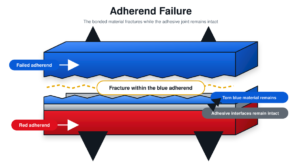
This type of failure can indicate the bond is stronger than the adherend, but it does not say that the complete assembly is successful. An effective joint assembly should be able to transfer load through the entire structure. If the adherend fails to carry that load, the assembly still requires redesign.
Adherend failure is more likely when the material is thin, brittle, porous, damaged, or weakened by machining. Holes, notches, grooves, sharp corners, and abrupt changes in thickness can reduce the surface area and concentrate stress. A strong, stiff adhesive may not deform much, so the transfer of force can occur more abruptly from one adherend to the other. These stress concentrations can lead to eventual adherend failure.
Environmental deterioration is also a factor. Wood can split after moisture exposure, polymers can become brittle through UV exposure, and metal can corrode. In these cases, the adhesive remains intact while the surrounding material degrades.
Prevention requires more sturdy adherends, local reinforcement, smoother changes in thickness, a larger-load transfer area, or an adhesive with greater flexibility. The joint should be designed so that the bond edges, holes, and geometric transitions do not concentrate stress near the vulnerable areas of the adherend.
Coating, Primer, and Surface Layer Failure
An adhesive may remain attached to a coating while the coating separates from the material underneath it. Similar types of failure may occur with plating, primer, paint, oxide layer, composite ply, or a weak surface layer of concrete, plastic, or wood.
This type of failure is an indication of why the bonding procedure must be evaluated as an entire system. The joint is only as strong as its weakest link. A high-strength adhesive cannot compensate for an intermediate surface layer that is insufficiently attached to the substrate.
Prevention requires evaluation of which existing coatings are suitable for structural bonding. Weak or unknown coatings should be removed, and only approved primers and surface treatments should be qualified.
Mixed Failure
Mixed failure occurs when the fracture follows more than one path. Part of the joint may fail at the interface, while another part may fracture through the adhesive, and a third region may crack the adherend. Mixed failure is common because surface condition, adhesive thickness, curing, and stress concentration are rarely identical across an entire joint.
The pattern can reveal how the failure developed. An interfacial failure near an edge may indicate contamination or moisture entry. A cohesive failure into the overlap may show the crack changed direction, and repeated regions of different failure types may indicate uneven preparation, voids, differing bond-line thickness, or non-uniform curing.
How to Examine a Failed Adhesive Joint
A failed joint should be regarded as evidence. The fracture surfaces should not be cleaned, scraped, touched without justification, or pressed back together. Both sides should be photographed and labelled so that matching regions can be compared. The location and orientation of the joint within the assembly should also be recorded.
The initial task is to identify the fracture path. Careful attention should be allotted to where the adhesive remains, whether the adherend material has been removed, and whether a coating has detached. The estimated percentage and location of interfacial, cohesive, adherend, and mixed failure should be noted.
The pattern of the fracture can help identify a probable cause. Grooves or patterns emanating from an edge or defect can show the direction of the crack growth. Voids, bubbles, corrosion, unusual color, soft adhesive, glossy unwetted regions, and abrupt thickness provide additional clues.
Manufacturing records should then be reviewed. Useful information includes the product and batch, storage history, surface preparation method, time between preparation and bonding, mixing ratio, application time, assembly pressure, clamping conditions, bond-line thickness, and cure conditions.
Service history is also important. The failure analysis should consider the actual load magnitude and direction, loading rate, number of cycles, impact events, vibration, temperature, moisture exposure, chemical exposure, UV exposure, and aging. The joint may have experienced environmental conditions not originally expected in the initial design assumptions.
Visual inspection may aid in, but not conclusively determine, the cause. Microscopy, which is the use of microscopes, can reveal thin adhesive residues, cracks, and surface layer anomalies. Chemical analysis may further identify contamination or degradation. Thermal analysis can evaluate the curing conditions. Mechanical tests can compare failed production material with correctly prepared specimens.
Witness panels or test coupons, if used, can provide useful comparisons. They are small specimens that are bonded alongside production components under the same assembly conditions. They can assist in assessing cure, strength, surface preparation, and process consistency without damaging the finished assembly.
Root Cause Analysis
Failure type is distinct from the root cause. Interfacial failure may mean failure occurred at the interface, but it does not tell you what contributed to it. The actual cause of the failure may be due to contamination, poor wetting, corrosion, moisture, thermal cycling, or excessive peel.
Many adhesive joint failures start off as small discrepancies that grow into larger problems. For example, a small void may not be a critical issue under a well aligned static load, but it can initiate fatigue when exposed to vibration and moisture.
A proper investigation into the cause of the failure involves possible explanations and tests involving the fracture pattern. Process records, service history, and material behavior should support the conclusions made by the analysis.
Once the root cause is established, corrective action must address the issue at the source. For example, a stronger adhesive may be a solution, but not if contamination and eccentric loading are still a concern. Representative testing to replicate the conditions under the proposed solution will help to confirm whether the issue is resolved.
Frequently Asked Questions
This section addresses some frequently asked questions regarding types of adhesive joint failures.
What is The Most Common Type of Adhesive Joint Failure?
There is no single failure type that is most common in every application. Interfacial failure is primarily caused by contamination, poor preparation, or environmental exposure, while cohesive failure can occur when the adhesive is overloaded or degraded. The common pattern depends on the materials, process, joint geometry, loading, and service environment.
What is the Difference Between Adhesive and Cohesive Failure?
Adhesive failure occurs when the adhesive breaks from the adherends, while cohesive failure occurs when the adhesive separates internally.
Does Adherend Failure Mean the Adhesive was Strong Enough?
It shows that there was no cohesive failure and that the local bond was stronger than the part of the adherend that fractured. It does prove that the complete assembly is not adequate. The adherend may need to be thickened, reinforced, or redesigned to carry the required load.
What Does a Clean Fracture Surface Indicate?
A primarily clean surface may suggest interfacial failure, incomplete wetting, or contamination. Appearance by itself is not an indicator of the root cause.
Can An Adhesive Joint Fail Without Separating Completely?
Yes, complete separation is not required for a decisive joint failure. Partial debonding, cracking, leakage, excessive creep, loss of stiffness, and movement beyond permitted tolerance all meet the requirements for joint failure even if the parts remain connected.
How Do Voids Affect Adhesive Joint Strength?
Voids reduce the effective bonding area and concentrate stress in the surrounding adhesive. Edge voids can initiate cracks and enable moisture or chemicals to enter. Their effect will vary depending on the size, location, shape, loading, and toughness of the overall system.
Can Moisture Cause an Adhesive Bond to Fail?
Yes. Moisture can interact with and weaken the interface, soften some adhesives, swell porous adherends, and increase corrosion. Environmental conditions, time, and materials involved will determine the effects of moisture on the joint.
Can a Failed Adhesive Joint be Rebonded?
Many joints are capable of being repaired, but the old adhesive, contamination, corrosion, and damaged material need to be removed first. Therefore, it may be easier to replace the joint with a substitute after correcting the cause of failure and following a validated procedure.
How Can Adhesive Joint Failures Be Prevented?
Prevention requires compatible materials, suitable joint geometry, controlled surface preparation, accurate mixing and application, correct bond-line thickness, adequate curing, realistic testing, and protection from the service environment. A single improvement is usually not enough to compensate for the integrity of the entire bonding system.
Conclusion
Adhesive joints can fail at the adhesive-adherend interface, within the adhesive, inside an adherend, within a coating or surface layer, or through several locations. These failure types describe where the fracture occurred. The causes of failure may be due to static overload, peel, cleavage, sudden impact, fatigue, creep, temperature, moisture, chemicals, corrosion, manufacturing defects, and poor geometry.
Accurate diagnosis is important to avoid future iterations from making the same mistake. Controlling or preventing adhesive joint failure is attributable to compatible materials, controlled surface preparation, suitable geometry, accurate application, complete curing, realistic testing, and correct inspection.

1 Comment
Pingback: Factors That Affect Adhesive Joint Strength - Bonding Station